How AI Is Helping Detect Skin Cancer Earlier
Australia has one of the highest rates of skin cancer in the world, with around two in three Australians diagnosed at some point in their lives. This is a combination of the Australian lifestyle and the climate. Early detection of any type of cancer is important, as it significantly improves the effectiveness of the treatment. In recent years, artificial intelligence (AI) has become an important diagnostic tool that aids medical staff in the earlier identification of skin cancer. By combining advanced imaging technologies with intelligent software, AI gives early, accurate information on skin cancer, allowing swift, appropriate treatment.

DermScreen
Australia has one of the highest rates of skin cancer in the world, with around two in three Australians diagnosed at some point in their lives. This is a combination of the Australian lifestyle and the climate. Early detection of any type of cancer is important, as it significantly improves the effectiveness of the treatment. In recent years, artificial intelligence (AI) has become an important diagnostic tool that aids medical staff in the earlier identification of skin cancer. By combining advanced imaging technologies with intelligent software, AI gives early, accurate information on skin cancer, allowing swift, appropriate treatment.
Skin Health Check Sydney CBD
Founded in 2022 by a group of Australian dermatologists who recognised the widespread problems with skin cancer in this country, Skin Health Check decided to improve melanoma survival rates by using early detection methods. We do this through humanised yet modern technology, providing affordable, accessible, convenient skin screening in our three Sydney clinics. Visit us at Mosman, Bondi Junction and Sydney CBD.
How are AI Systems Used in Skin Cancer Detection?
The AI systems used in skin cancer detection use deep learning algorithms to analyse images of skin lesions. These systems are trained on large datasets containing earlier images of both benign (non-cancerous) and malignant (cancerous) lesions. In some cases, millions of images have been studied. Over time, the AI systems learn to distinguish the patterns, colours, and structural features that tend to indicate early-stage cancer. This means AI systems can assess dermoscope images and indicate anything that looks suspicious, assigning a score that indicates the level of risk. Doctors can then conduct a closer examination of anything that shows some level of risk, and decide if a biopsy or other form of closer investigation is needed.
Presently, AI has been shown to be comparable to the best human expert dermatologists in controlled settings.
How Does AI Improve Accuracy and Treatment Times?
A noteworthy advantage of AI is its ability to consistently analyse large amounts of data in relatively short periods of time. Unlike even the most dedicated health care professionals it does not suffer fatigue which can impair clinical decision making. This helps to achieve accurate, consistent results.
AI systems are particularly effective at identifying early warning signs using the ABCDE rule:
Asymmetry
Border irregularity
Colour variation
Diameter
Evolution over time
AI systems can detect subtle changes that might not always appear obvious to the human examiner. This allows potential problems to be detected as early as possible, meaning faster diagnosis and earlier treatment. This means fewer unnecessary biopsies; patients need not undergo unneeded invasive procedures.
What is Total Body Photography and 3D Skin Mapping
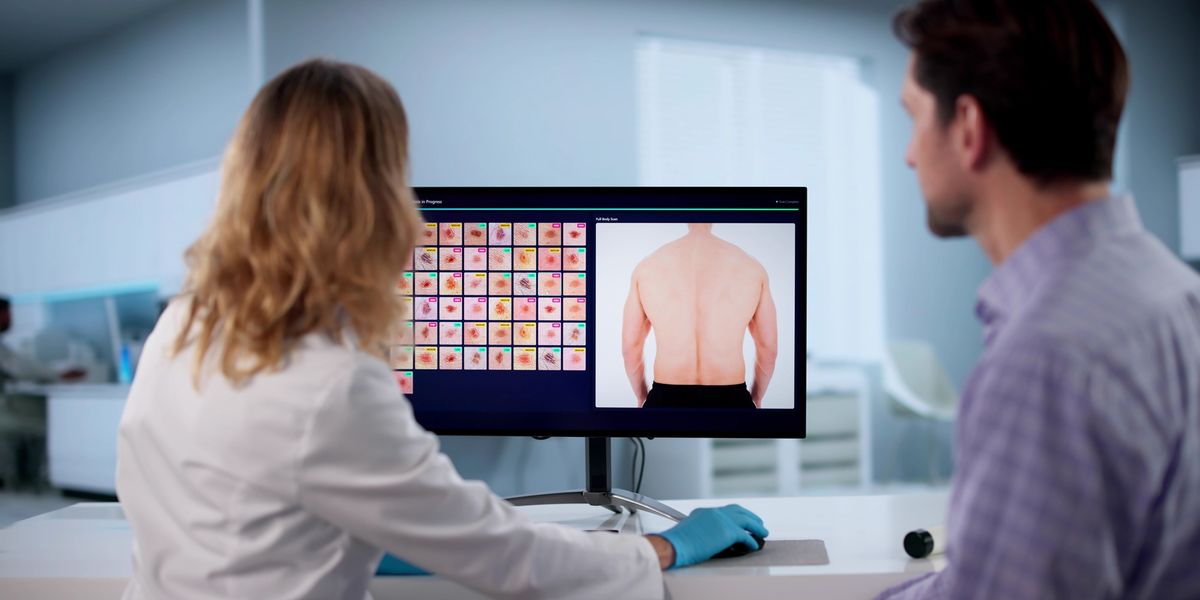
Total Body Photography (TBP) has become a useful means of modern skin cancer detection, especially valued for higher risk patients. This technology captures high-resolution images of the entire skin surface, creating a detailed baseline for future comparison. The individual images can be used to create a 3D map of an individual’s body. New body maps can be compared to previous maps, and any suspicious changes are quickly detected.
Body maps can show:
- New moles or lesions
- Changes in existing spots
- Subtle differences that may indicate early cancer
This type of technology is especially useful for individual clients who have dark freckled skin, a large number of moles, or a history of melanoma. Software now can allow the entire surface of skin to be routinely monitored and checked with minimal inconvenience.
What Are Mobile Dermoscopy and Point-of-Care Tools?
Dermoscopy is a non-invasive technique that uses magnification and specialised lighting to examine skin lesions in detail. Mobile dermoscopy means using a device and app on a mobile phone that allow clinicians to capture high-quality images and analyse them instantly.
Modern mobile dermoscopy devices usually feature:
- Up to 20x magnification
- Cross-polarised lighting to reduce surface reflection
- Immediate digital image capture
In primary care settings, handheld tools can assist general practitioners in identifying high-risk lesions and determining whether a referral to a specialist is required – DermScreen supports a service called DermAssist specifically for this type of workflow. Some devices also use additional technologies, such as light spectroscopy, to assess subsurface skin structures. These tools help bring specialist-level diagnostic support into everyday clinical environments.
How are Intelligent Software Platforms Used in Skin Cancer Detection?
AI is about both individual devices, and their integration into a larger system. The images and data from individual devices can be uploaded into a broader software platform. This provides several services:
- AI-assisted image analysis
- Secure storage of patient images and history
- Streamlined reporting tools
- Patient portals for communication and monitoring
By combining imaging, analysis, and record-keeping, these systems allow for more efficient and organised skin health management. Doctors can track changes over time, compare images easily, and make more informed decisions.
How Does AI Technology Help Those in Remote Areas?
People living in remote areas may have limited access to medical services, especially specialised services like dermatology. This is a noticeable problem in Australia given its large area and uneven spread of population. People living in the outback towns previously needed to travel to coastal cities to access specialist services. AI is helpful in these situations by enabling remote screening and telehealth consultations. Patients can take smartphone images of suspicious skin blemishes, and send them via secure platforms like DermAssist. This means only those with legitimate risks need to make the journey for medical diagnosis. This has the added bonus of reducing waiting times. The AI online analysis is quite quick. And the waiting time for patients in the clinic is much shorter when the low-risk problems have already been screened out.
What are the Limitations to AI, and the Role of Doctors?
While AI is useful for sorting large amounts of data, and providing consistent results, it will never cover every situation. The medical staff are still needed to assess the clients who are found to have legitimate or at least suspicious looking skin conditions.
Some limitations Include:
- Reduced accuracy if the images are poor-quality
- It may not always detect rare cancers, or recognise a new form of cancer.
- It required a large amount of diverse initial data for training
- It should have access to the patient’s medical history
Doctors consider a wide range of factors beyond visual appearance, including medical history, sun exposure, and changes reported by the patient. Yet, by keeping records online and updating them frequently, modern technology can give doctors access to good quality, current information for each individual patient. This greatly benefits diagnosis and treatment.
What is expected for The Future of AI in Skin Cancer Detection?
AI technology continues to evolve. Future developments are likely to include:
- More diverse datasets to improve accuracy across all skin tones
- Personalised risk assessments based on genetics and lifestyle
- Integration with wearable devices that monitor UV exposure
- Multi-modal systems combining imaging with patient data
These advancements aim to make skin cancer detection more accurate, accessible, and personalised.
Our Clinics for Skin Health Check Sydney CBD
AI has the potential to make a huge contributions in the detection of skin cancers. The main advantages are the ability to screen out unthreatening and benign conditions so that doctors can concentrate their services on patients with and streamline care.